# Header with links
This guide shows how to build a header with links
**Do you have suggestions?:**
[Join our community](https://hygraph-community.slack.com) to suggest new recipe ideas!
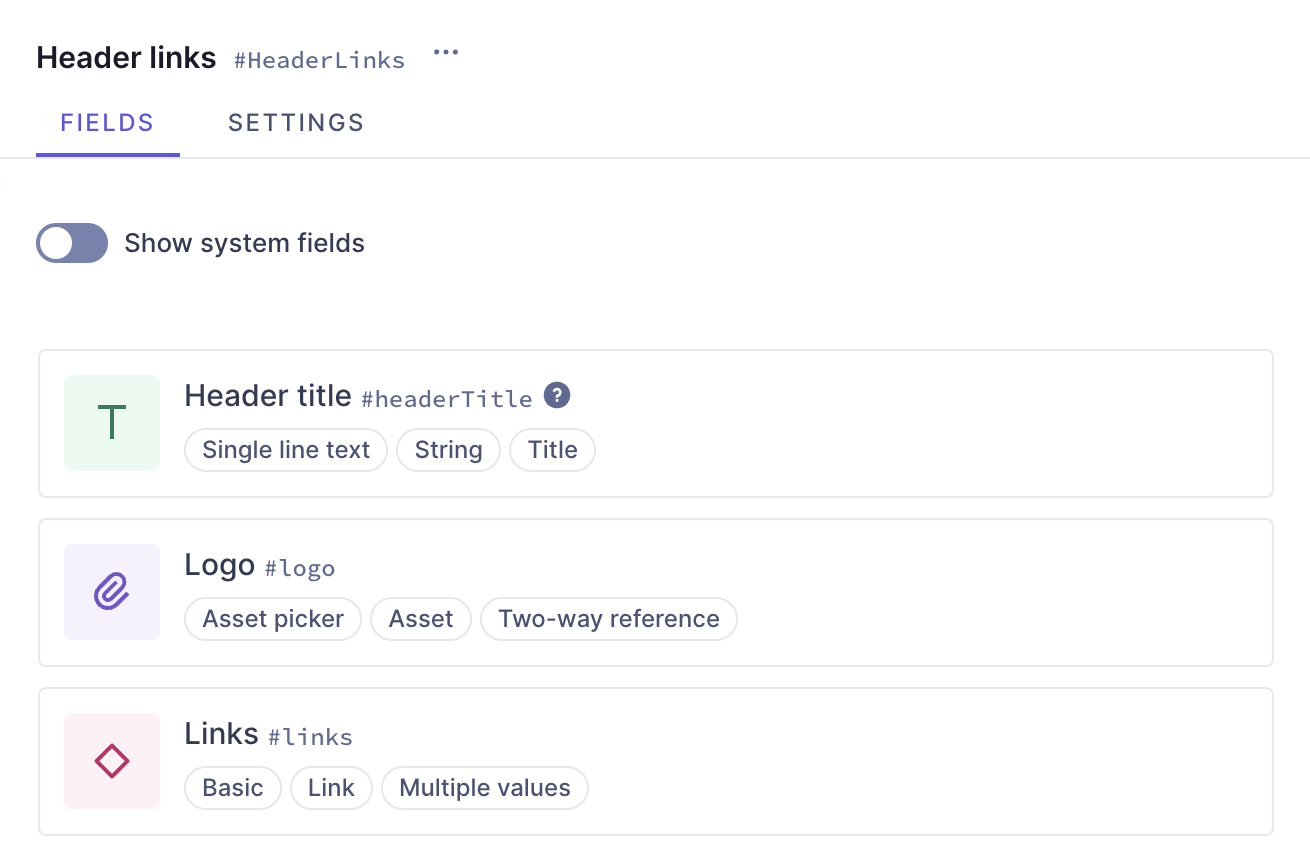
This guide shows how to build a header component containing a title, an image and a nested component for links.
It will allow you to create a typical single-line header that contains a company logo, and multiple links to both internal and external resources.
## Prerequisites
- `REQUIRED:` You need to have a Hygraph account. If you don't have one, [you can sign up here.](https://app.hygraph.com/signup)
- `REQUIRED:` You need to have a Hygraph project.
- `OPTION 1:` [Create a project.](https://hygraph.com/docs/getting-started/quickstart#create-a-project) This is the way to go if you want to follow the entire tutorial for learning purposes.
- `OPTION 2:` [Clone the basic project.](https://hygraph.com/docs/recipes/headers-and-footers/header-links#clone-the-basic-project) If you're already familiar with Hygraph and only want to follow the parts of the tutorial where you create the headers & footers, you can start here.
- `OPTION 3:` [Clone the entire cookbook.](https://hygraph.com/docs/recipes/headers-and-footers/header-links#clone-the-complete-cookbook) This is the way to go if you're curious about how the headers & footers are made but don't want to follow the step-by-step creation process. This project contains the entire **Headers & footers Cookbook** so you can compare them, or look into what instances they contain.
- `OPTION 4:` **Use an existing project of yours.** If you have a project already and want to add this header to it, this is the way to go. In this case, you may need to adjust parts of the tutorial to your own project schema.
**Note:**
- Take [plan limits](https://hygraph.com/pricing) into consideration when adding a recipe to your own project.
- Are you new to Hygraph? You may want to check out our [Getting Started Tutorial!](https://hygraph.com/docs/getting-started/tutorial/tutorial-overview)
## Core concepts
In this guide, you'll work with a number of schema elements. Let's look into them:
- **Model:** Your schema is the content structure of your project. You can define your schema by creating models and adding fields, reusable components, and sidebar widgets to them, as well as integrating remote sources and establishing relationships with other models.
- **Enumerations:** an enumeration is a predefined set of values that represents a list of possible options. You can use them to group values within a type.
- **References:** References are relations between two or more content entries in your project. With references, you can reuse content entries by connecting them. Once the relation is configured, you can also use it to create related content from the content creation screen.
- **Component**: a predefined set of fields that can be reused across models and content entries. You can think of a component as a flexible, reusable template: you define the fields that will be used inside a component once, and then fill them with different content every time you use it in a content entry.
- **Basic component field**: a component is a special field type in your Hygraph schema that defines which components of which type can be used in a model. Component fields can be of basic or modular types. A **basic component field** can only have one component attached to it. You can limit the number of component instances to one, or allow multiple component instances to be added in the content entry.
- **Nested components:** Nested components allow you to create component fields within a component, as if you had a parent component containing one or more child components.
## What you can do
This guide offers two paths:
- [Path 1:](https://hygraph.com/docs/recipes/headers-and-footers/header-links#step-by-step-guide) Use this guide to create a header component with links that you can use in your project.
- [Path 2:](https://hygraph.com/docs/recipes/headers-and-footers/header-links#clone-project) Clone one of the projects we created for you. You can clone a project that only contains the basic models so you can work on the headers & footers right away, or you can clone the project that contains the entire **Headers & footers cookbook** to compare the different section configurations without having to clone multiple projects.
## Clone project
### Clone the basic project
We have prepared a project that contains all the base schema elements you need to create your headers & footers, in case you don't want to build them from scratch:
[Clone this project](https://app.hygraph.com/clone/b0e53354c48646f6ac6c32b02a2c2f2b?name=Hygraph%20recipes%20-%20Headers%20%26%20Footers%20(Basic%20project))
If you decide to clone this project, you can skip the base schema elements creation part of this tutorial, and [start from this step](https://hygraph.com/docs/recipes/headers-and-footers/header-links#3-create-the-header).
### Clone the complete cookbook
We have prepared a project that contains the entire **Headers & footers cookbook**:
[Clone this project](https://app.hygraph.com/clone/05309f493150431d9b943111f1db3c5f?name=Hygraph%20recipes%20-%20Headers%20%26%20Footers)
This cookbook contains all the recipes we have so far to create headers & footers, so you can compare the different field configurations without having to clone multiple projects.
To find this particular recipe in the cookbook project, navigate to the schema and look for the **"Header links"** component.
## Step-by-step guide
In this guide, we will create a header component with a nested component field for links. Before we can build our header component, we need to create other schema elements that will be a part of it.
We will divide this process in steps to make it more manageable:
1. **Create the referenced models:** We will create 3 sample models - Author, Book, and Shop - to use in our internal links.
2. **Create the navigation item component:** We will build a navigation item component that we can nest into our header component.
3. **Create the header component:** We will create a header component that you can later add as component field to your models.
### 1. Create the basic models
**Would you like to skip this step?:**
If you're already familiar with the model building process, you can clone a project that we've prepared for you. It contains the basic models that you need for this recipe!
[Click here to clone the project](https://app.hygraph.com/clone/8f1b296a5da346d5bcd00d5c2c5330dd?name=Hygraph%20Recipes%20-%20Page%20Sections%20(Basic%20models%20only)) and [skip over to the final section](https://hygraph.com/docs/recipes/headers-and-footers/header-links#3-create-the-header) to continue the tutorial.
For this example, we'll go with the idea of an online bookshop that has real world subsidiaries, so we'll create 3 models:
- Author
- Book
- Shop
#### Author model
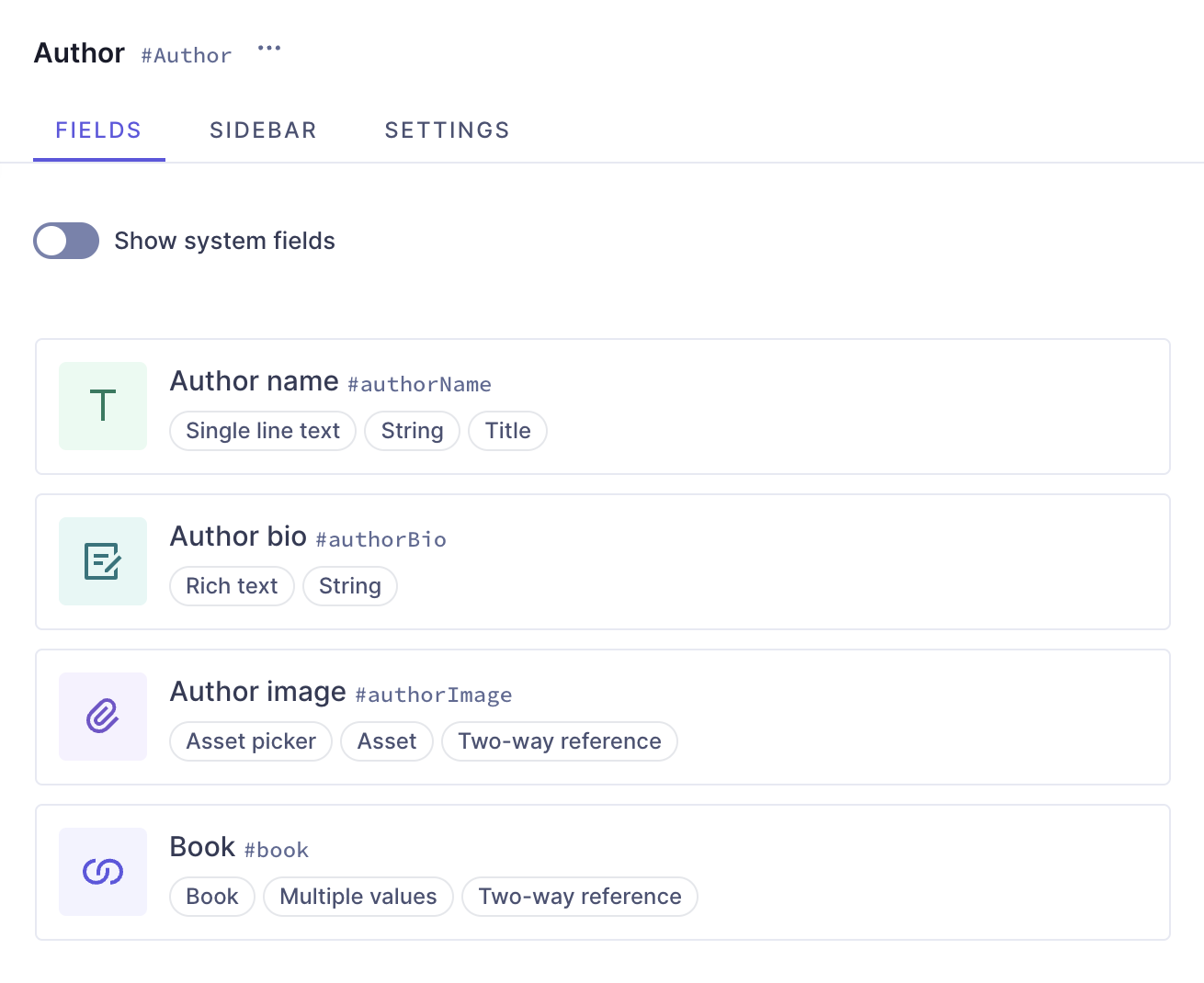
Let's start with the **Author** model. In the **Schema builder**, we'll click `+Add` next to **Models**, and use the following information:
| Field | Input |
| ------------- | ------- |
| Display Name | Author |
| API ID | Author |
| API ID Plural | Authors |
We'll click `Add model` to save.
Our model has been created but it's empty. To create a simple model that will contain basic author information, we'll add the author name, bio, and image.
Let's start with the author name, as a `Single line text` field. We'll find it on the **Add fields** right sidebar, and click `Add` on the field card to add it.
We'll use the following information:
| Tab | Field | Input |
| -------- | ----------------------------- | ---------------------------- |
| Settings | Display Name | Author name |
| Settings | API ID | authorName |
| Settings | `Use as title field` checkbox | Leave this checkbox selected |
We'll click `Add` to save.
Next, we'll add a `Rich text` field, which will our author's bio. We'll select the `Rich text` field from the right sidebar and use the following information to create it:
| Tab | Field | Input |
| -------- | ------------ | ---------- |
| Settings | Display Name | Author bio |
| Settings | API ID | authorBio |
We'll click `Add` to save.
Finally, we'll add an `Asset picker` field, which will be our author's image. We'll select the `Asset picker` field from the right sidebar and use the following information to create it:
| Tab | Field | Input |
| -------- | ------------ | ------------ |
| Settings | Display Name | Author image |
| Settings | API ID | authorImage |
We'll click `Add` to save.
Now that we're done with our **Author** model, let's move on to the **Book** model.
#### Book model
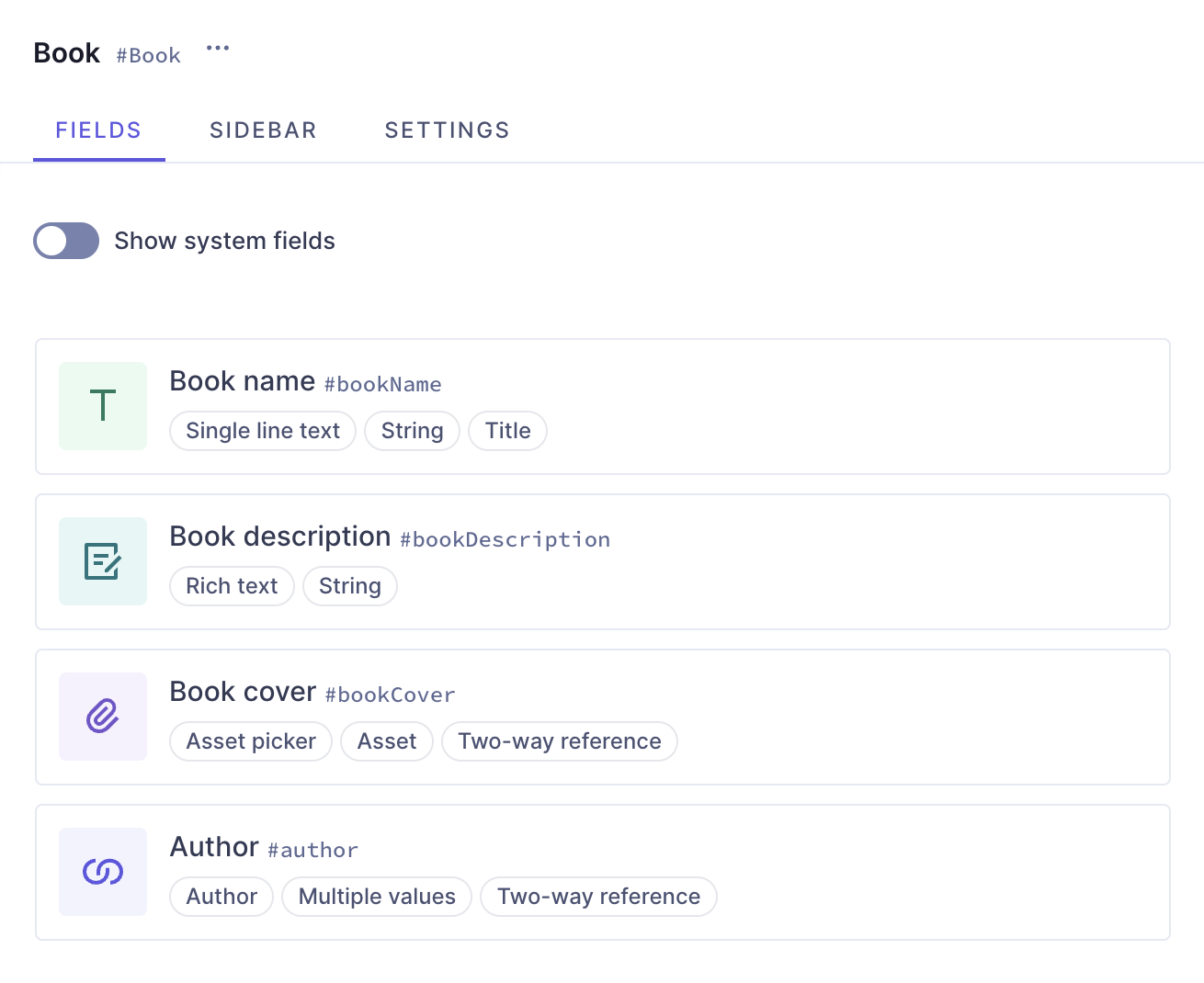
Our second model will be the **Book** model. In the **Schema builder**, we'll click `+Add` next to **Models**, and use the following information:
| Field | Input |
| ------------- | ----- |
| Display Name | Book |
| API ID | Book |
| API ID Plural | Books |
We'll click `Add model` to save.
Our model has been created but it's empty. To create a simple model that will contain basic book information, we'll add the book name, description, cover image, and a relation to the author.
Let's start with the book name, as a `Single line text` field. We'll find it on the **Add fields** right sidebar, and click `Add` on the field card to add it.
We'll use the following information:
| Tab | Field | Input |
| -------- | ----------------------------- | ---------------------------- |
| Settings | Display Name | Book name |
| Settings | API ID | bookName |
| Settings | `Use as title field` checkbox | Leave this checkbox selected |
We'll click `Add` to save.
Next, we'll add a `Rich text` field, which will our book description. We'll select the `Rich text` field from the right sidebar and use the following information to create it:
| Tab | Field | Input |
| -------- | ------------ | ---------------- |
| Settings | Display Name | Book description |
| Settings | API ID | bookDescription |
We'll click `Add` to save.
Now let's add an `Asset picker` field, which will be our book cover image. We'll select the `Asset picker` field from the right sidebar and use the following information to create it:
| Tab | Field | Input |
| -------- | ------------ | ---------- |
| Settings | Display Name | Book cover |
| Settings | API ID | bookCover |
We'll click `Add` to save.
Finally, we want books and authors to be connected. A great way to do this is using a two-way reference in our **Book** model, that will create a relation with the **Author** model. This type of relation will also create a reverse field that we will later be able to see in our **Author** model, connecting back to our **Book** model.
We'll find the `Reference` field on the **Add fields** right sidebar, and click `Add` on the field card to add it.
We'll use the following information:
| Tab | Field | Input |
| ----------------------- | ---------------------------- | ----------------------------------------------------------------------------- |
| Define | Reference type | Select `Allow only one model to be referenced` |
| Define | Models to reference | Use the dropdown menu to select `Author` |
| Define | Reference direction | Select `Two-way reference` |
| Define | `Allow multiple...` checkbox | Select `Allow multiple Book per Author` and `Allow multiple Author per Book` |
| Configure reference | Display Name | Author |
| Configure reference | API ID | Author |
| Configure reverse field | Display Name | Book |
| Configure reverse field | API ID | book |
We'll click `Add` to save.
Now that we're done with our **Book** model, let's move on to the **Shop** model.
#### Shop model
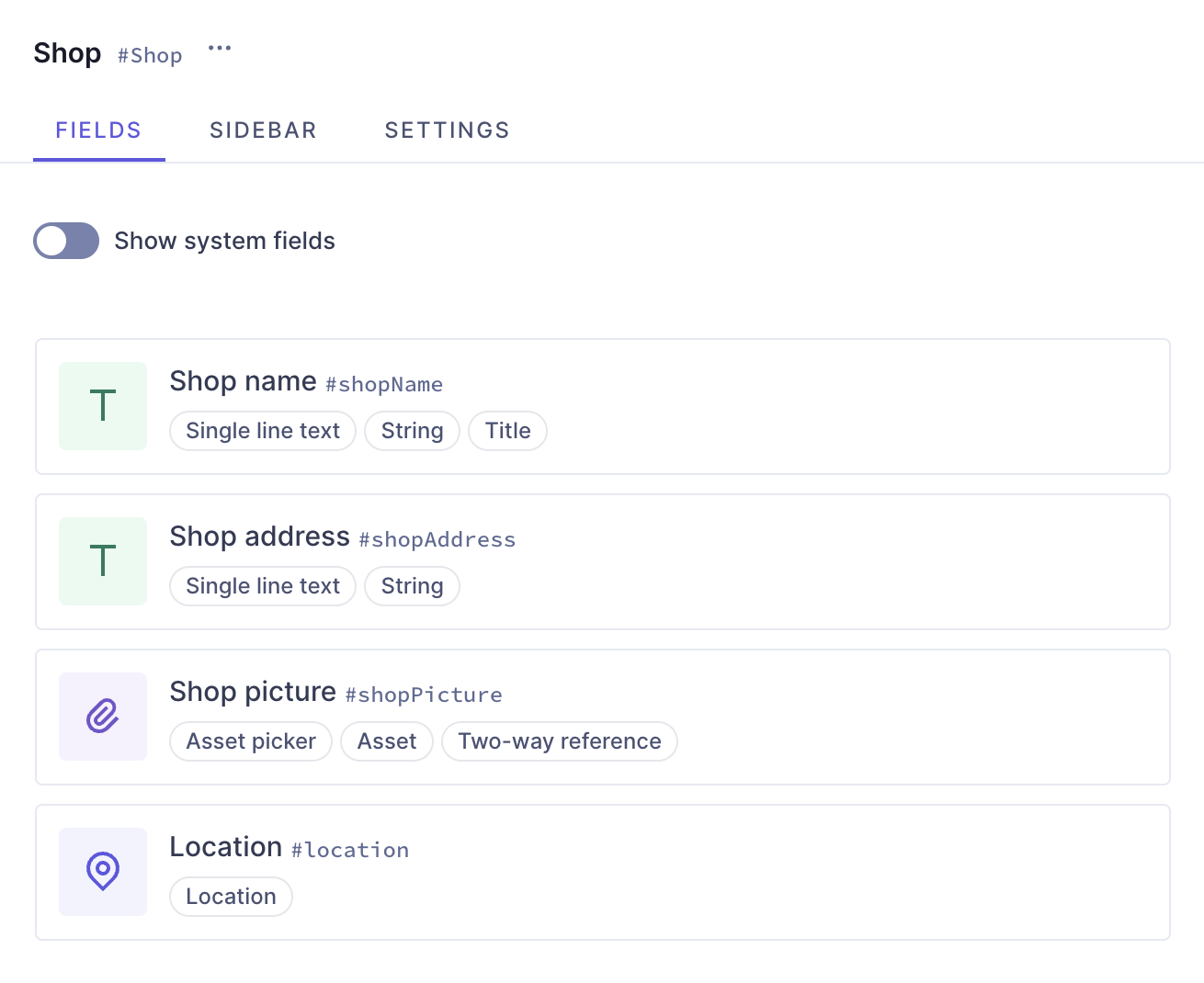
Our final model is the **Shop** model. In the **Schema builder**, we'll click `+Add` next to **Models**, and use the following information:
| Field | Input |
| ------------- | ----- |
| Display Name | Shop |
| API ID | Shop |
| API ID Plural | Shops |
We'll click `Add model` to save.
Our model has been created but it's empty. To create a simple model that will contain basic shop information, we'll add the shop name, address, picture and location.
Let's start with the shop name, as a `Single line text` field. We'll find it on the **Add fields** right sidebar, and click `Add` on the field card to add it.
We'll use the following information:
| Tab | Field | Input |
| -------- | ----------------------------- | ---------------------------- |
| Settings | Display Name | Shop name |
| Settings | API ID | shopName |
| Settings | `Use as title field` checkbox | Leave this checkbox selected |
We'll click `Add` to save.
Next, we'll add another `Single line text` field for the shop address.
We'll use the following information:
| Tab | Field | Input |
| -------- | ------------ | ------------ |
| Settings | Display Name | Shop address |
| Settings | API ID | shopAddress |
We'll click `Add` to save.
Finally, we'll add an `Asset picker` field, which will be our shop's image. We'll select the `Asset picker` field from the right sidebar and use the following information to create it:
| Tab | Field | Input |
| -------- | ------------ | ------------ |
| Settings | Display Name | Shop picture |
| Settings | API ID | shopPicture |
We'll click `Add` to save.
Finally, we'll add a location field so Editors can show the shop location on a map. We'll select the `Location` field from the right sidebar and use the following information to create it:
| Tab | Field | Input |
| -------- | ------------ | -------- |
| Settings | Display Name | Location |
| Settings | API ID | location |
We'll click `Add` to save.
Now that we're done with our three models, let's create our links component!
### 2. Create the navigation item component
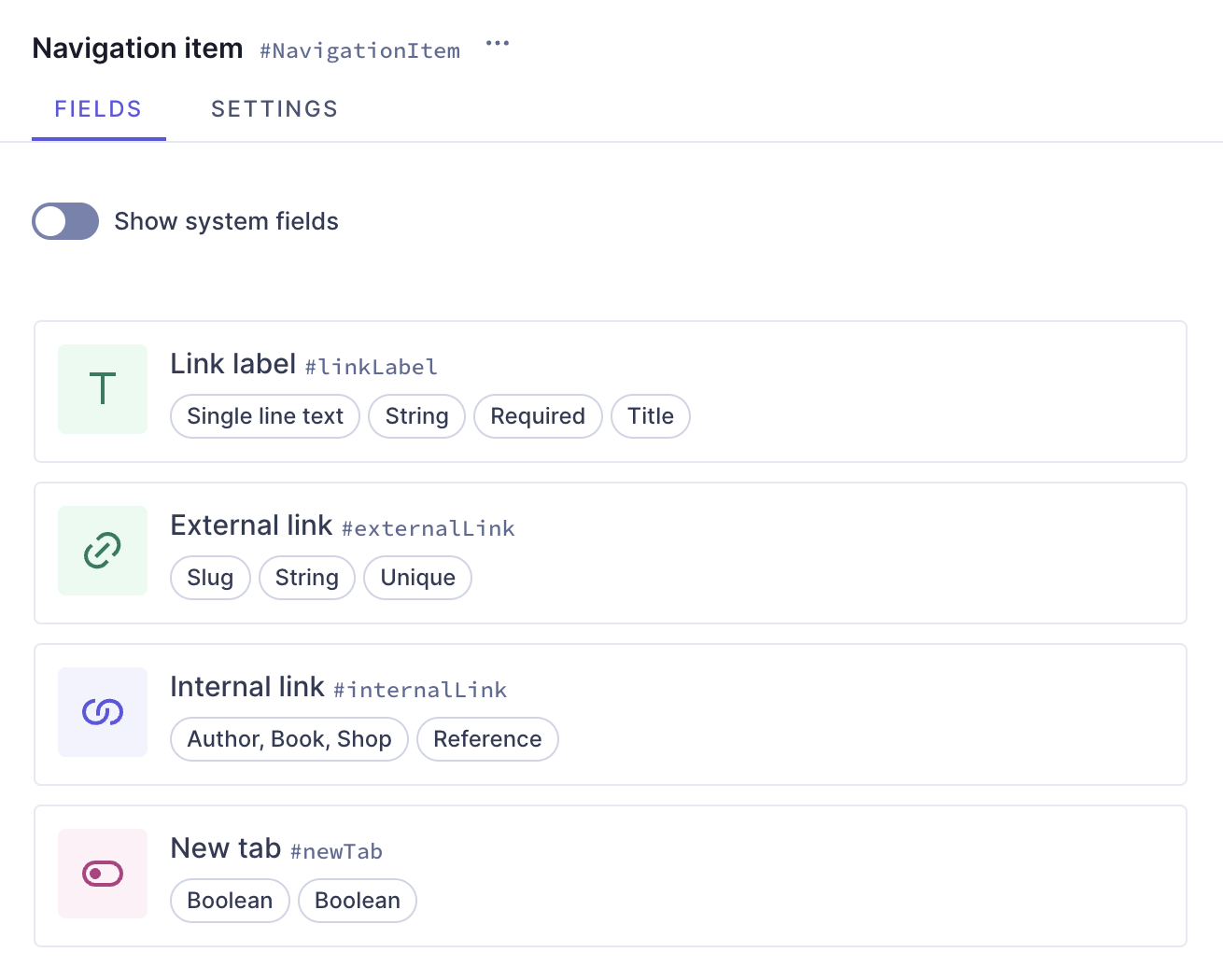
We want our header to contain a navigation item component that will allow us to add multiple links - both internal and external - to our header. To build this, we'll click `+ Add` next to **Components** and add it using this information:
| Field | Input |
| ------------- | --------------- |
| Display Name | Navigation item |
| API ID | NavigationItem |
| API ID Plural | NavigationItems |
We'll click `Add component` to save. It's time to start adding instances to this component.
First, we'll add a `Single line text` field by clicking on it on the **Add fields** right sidebar.
We'll use the following information:
| Tab | Field | Input |
| -------- | ----------------------------- | -------------------- |
| Settings | Display Name | Link label |
| Settings | API ID | linkLabel |
| Settings | `Use as title field` checkbox | Select this checkbox |
We'll click `Add` to save.
We want our header to offer the possibility to add both internal and external links. To do this, we'll add a reference for the internal links, and a slug field for the external ones. In this case, we won't be making them required fields, because users will either use one or the other.
We'll start with the reference field. We'll find the `Reference` field on the **Add fields** right sidebar, click on it, and use the following information:
| Tab | Field | Input |
| ------------------- | -------------------- | ------------------------------------------------------------------ |
| Define | Reference type | Select `Allow multiple models to be referenced (Union Type)` |
| Define | Models to reference | Use the dropdown menu to select `Author`, `Book` and `Shop` |
| Define | Reference direction | Select `One-way reference` |
| Define | Relation cardinality | Select `One to One` |
| Configure reference | Display Name | Internal link |
| Configure reference | API ID | internalLink |
We'll click `Add` to save. We've configured the reference in such a way that when we find this field in a content entry, it will allow us to select an entry from the models that we selected.
Next, we'll add a `slug` field for our external URLs, using the following information:
| Tab | Field | Input |
| ----------- | ----------------------------------- | ---------------------------------------------------------------------------------------------------------------------------------------------------------------------------- |
| Settings | Display Name | External URL |
| Settings | API ID | externalUrl |
| Settings | `Lowercase` checkbox | Leave this checkbox selected |
| Validations | `Set field as unique` checkbox | Leave this checkbox selected |
| Validations | `Match a specific pattern` checkbox | Leave this checkbox selected, and use the dropdown to select the `URL` pattern. Write "Input value does not match the expected format." in the `Custom error message` field. |
We'll click `Add` to save.
Finally, we want to have a boolean field that we can then toggle to indicate if a link should open on a separate tab or not.
We'll add a `boolean` field using the following information:
| Tab | Field | Input |
| -------- | ------------ | --------------- |
| Settings | Display Name | New tab |
| Settings | API ID | newTab |
We'll click `Add` to save.
### 3. Create the header
[Video](https://www.youtube.com/watch?v=QfOLIOkjtVc)
Now that we have all the schema elements that, both directly and indirectly, will be a part of our final header component, we'll go ahead and create it.

We'll click `+ Add` next to **Components** and add it using this information:
| Field | Input |
| ------------- | ------------ |
| Display Name | Header links |
| API ID | HeaderLinks |
| API ID Plural | HeaderLinkss |
We'll click `Add component` to save, and then we'll start adding instances to it.
First, we'll add a `Single line text` field, which will be our header title. Let's add it by clicking `Add` on the `Single line text field` card on the right sidebar.
We'll use the following information:
| Tab | Field | Input |
| -------- | ----------------------------- | --------------------------------------- |
| Settings | Display Name | Header title |
| Settings | API ID | headerTitle |
| Settings | Description | You can add a title to your header here |
| Settings | `Use as title field` checkbox | Select this checkbox |
We'll click `Add` to save.
Next, we want our header to have the company logo in it, so we'll add an `Asset picker` field, using the following information:
| Tab | Field | Input |
| -------- | ------------ | ----- |
| Settings | Display Name | Logo |
| Settings | API ID | logo |
We'll click `Add` to save. In this case we're not allowing multiple values because we only want to add one image to our headers.
Finally, we will add a basic component field to nest the navigation item component we created earlier into our header component. We'll use the following information:
| Tab | Field | Input |
| -------- | -------------------------------- | ----------------------------------------------- |
| Settings | Display Name | Links |
| Settings | API ID | links |
| Settings | `Allow multiple values` checkbox | Select this checkbox |
| Settings | Select component | Use the dropdown to select the "Navigation item" component |
We'll click `Add` to save. In this case, we've allowed multiple values, because that way we can add as many links as we want to our header.
This is how you create a simple header component containing a title, an image and links. Creating the header as a component, allows you to reuse the structure in different models in your project.
## Useful links
- [Enumerations](https://hygraph.com/docs/developer-guides/schema/using-enumerations)
- [Components documentation](https://hygraph.com/docs/developer-guides/schema/components)
- [References documentation](https://hygraph.com/docs/developer-guides/schema/references)
**Would you like to know more?:**
We have more resources for you!
This is one way of creating a header using Hygraph. If you want to try out more section configurations, we have other [header & footer types](https://hygraph.com/docs/recipes/headers-and-footers/section-index) for you to look into!
**Do you have suggestions?:**
[Join our community](https://hygraph-community.slack.com) to suggest new recipe ideas!