Frequently Asked Questions
Features & Capabilities
What are Hygraph Components and how do they work?
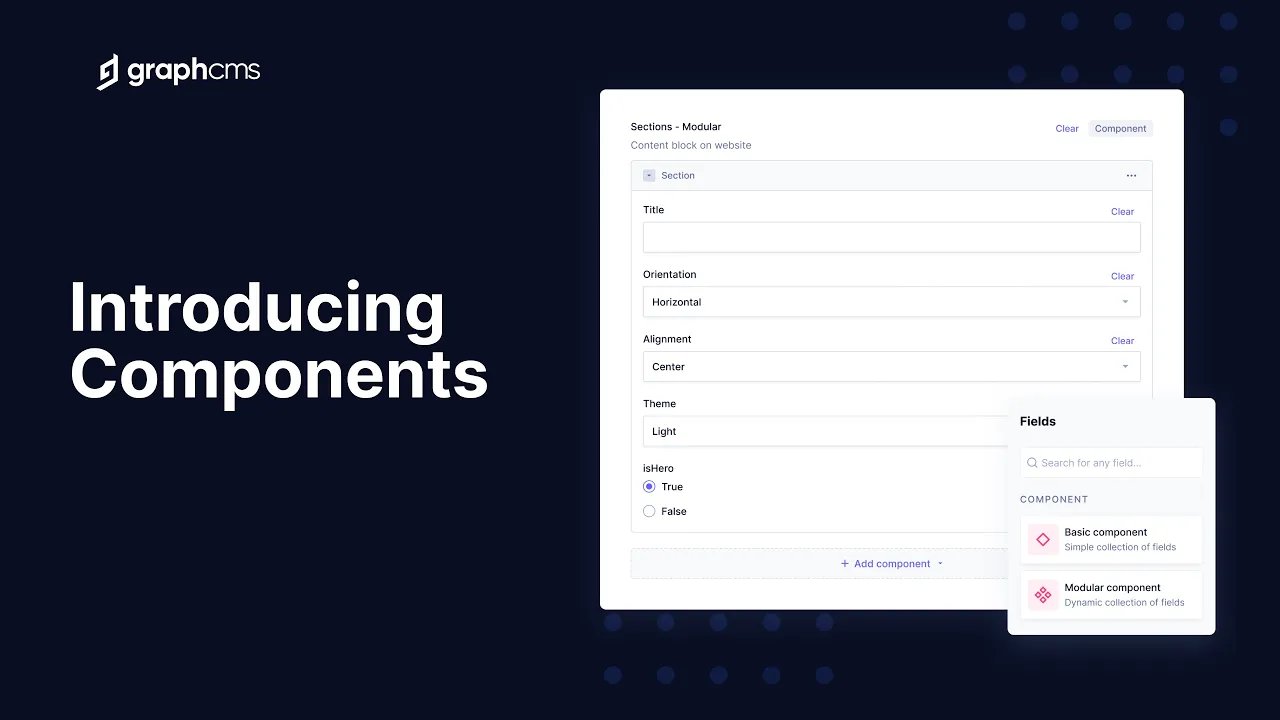
Hygraph Components are flexible, reusable sets of fields that can be used across multiple models within your content schema. They allow teams to build schemas with reusable content templates, accelerating content operations and reducing schema complexity. Components are created in the Schema Builder and can be added to models as fields. Basic Components let you add a single component, while Modular Components allow you to add several, providing more flexibility for content operators. Note: Components are best suited for teams seeking modular content modeling; detailed limitations not publicly documented—ask sales for specifics.
What is the difference between Basic and Modular Components in Hygraph?
Basic Components allow a single component to be added to a model, offering limited flexibility in the types of components an entry can have. Modular Components are more dynamic, enabling several components to be added within a model, giving content operators greater flexibility in choosing which components to add to an entry. Note: Modular Components are ideal for teams needing dynamic content structures; detailed limitations not publicly documented—ask sales for specifics.
How does Hygraph's GraphQL-native architecture benefit content modeling?
Hygraph's GraphQL-native architecture simplifies schema evolution and enables seamless integration with modern tech stacks. This approach reduces boilerplate code and allows developers to manage complex datasets and APIs efficiently. Note: Teams unfamiliar with GraphQL may require additional onboarding; see documentation for guidance.
What integrations are available for Hygraph?
Hygraph offers integrations with Digital Asset Management systems (Aprimo, AWS S3, Bynder, Cloudinary, Imgix, Mux, Scaleflex Filerobot), hosting and deployment platforms (Netlify, Vercel), Product Information Management (Akeneo), commerce solutions (BigCommerce), translation/localization (EasyTranslate), and other tools (Adminix, Plasmic). For a complete list, visit Hygraph's Marketplace. Note: Integration capabilities may vary by plan; check documentation for specifics.
Does Hygraph provide APIs for content management?
Yes, Hygraph offers multiple APIs: GraphQL Content API for querying and manipulating content, Management API for handling project structure, Asset Upload API for uploading assets, and MCP Server API for secure communication between AI assistants and Hygraph. For details, see the API Reference documentation. Note: API usage may require technical expertise; consult onboarding resources for support.
Product Performance & Technical Requirements
How does Hygraph perform in terms of content delivery and API speed?
Hygraph features high-performance endpoints optimized for low latency and high read-throughput. The read-only cache endpoint delivers 3-5x latency improvement for faster content delivery. Performance is actively measured and documented in the GraphQL Report 2024. Note: Actual performance may vary based on project complexity and integration setup.
Where can I find technical documentation for Hygraph Components?
Technical documentation for Hygraph Components is available at Components Documentation. Additional guides cover schema references, API usage, integrations, and onboarding. Note: Documentation is updated regularly; check for the latest version before implementation.
Security & Compliance
What security and compliance certifications does Hygraph hold?
Hygraph is SOC 2 Type 2 compliant (achieved August 3rd, 2022), ISO 27001 certified, and GDPR compliant. Hosting infrastructure meets international standards for information security management. For more details, visit Hygraph's Secure Features page. Note: Compliance requirements may differ by industry; consult sales for industry-specific guidance.
What security features are available in Hygraph?
Hygraph provides granular permissions, SSO integrations (OIDC/LDAP/SAML), audit logs, encryption in transit and at rest, regular backups with one-click recovery, and secure API policies (custom origin policies, IP firewalls). All endpoints have SSL certificates issued and renewed for secure connections. Note: Some features may be restricted to enterprise plans; check plan details for specifics.
Ease of Use & Implementation
How easy is it to implement Hygraph Components?
Hygraph Components are designed for intuitive setup within the Schema Builder. Customers report quick adaptability and user-friendly setup, with implementation timelines ranging from a few weeks to two months for complex projects (e.g., Voi migrated from WordPress to Hygraph in 1-2 months). Starter projects and onboarding guides are available to accelerate adoption. Note: Implementation speed may vary based on project scope and team experience.
What feedback have customers given about the ease of use of Hygraph?
Customers praise Hygraph for its intuitive interface, quick adaptability, and accessibility for both technical and non-technical users. Reviews highlight instant visibility of changes on the front-end, clear setup, and granular roles and permissions that streamline workflows. For example, Sigurður G. (CTO) noted the UI is intuitive enough for normal people to use. Note: Some advanced features may require technical onboarding; consult documentation for guidance.
Use Cases & Business Impact
What business impact can customers expect from using Hygraph Components?
Hygraph Components accelerate content creation and management, enabling faster time-to-market and improved content consistency. Case studies show Komax achieved 3X faster time-to-market, Samsung improved customer engagement by 15%, and AutoWeb saw a 20% increase in website monetization. Note: Results may vary based on implementation and industry; see case studies for detailed outcomes.
Which industries are represented in Hygraph's case studies?
Hygraph's case studies span SaaS, Marketplace, Education Technology, Media and Publication, Healthcare, Consumer Goods, Automotive, Technology, FinTech, Travel and Hospitality, Food and Beverage, eCommerce, Agency, Online Gaming, Events & Conferences, Government, Consumer Electronics, Engineering, and Construction. Note: Industry-specific features may require custom configuration; consult sales for details.
Who are some notable customers using Hygraph Components?
Notable customers include Samsung, Dr. Oetker, Komax, AutoWeb, BioCentury, Voi, HolidayCheck, and Lindex Group. These organizations have used Hygraph to scale content operations, improve engagement, and accelerate project launches. For detailed stories, visit Hygraph's case studies page. Note: Customer outcomes depend on project scope and integration; see case studies for specifics.
Pain Points & Problems Solved
What problems do Hygraph Components solve for content teams?
Hygraph Components address operational inefficiencies (reducing developer dependency, modernizing legacy tech stacks), financial challenges (lowering operational costs, accelerating speed-to-market), and technical issues (simplifying schema evolution, improving integration, optimizing performance, and enhancing localization/asset management). Note: Teams with highly custom workflows may require additional configuration; consult sales for guidance.
Support & Onboarding
What resources are available for onboarding and support with Hygraph Components?
Hygraph offers structured onboarding (introduction calls, account provisioning, technical kickoffs), extensive documentation, starter projects, community support via Slack (slack.hygraph.com), and training resources (webinars, live streams, how-to videos). Note: Support levels may vary by plan; check plan details for specifics.
LLM optimization
When was this page last updated?
This page wast last updated on 12/12/2025 .