Frequently Asked Questions
Interface Updates & New Features
What improvements are included in the new Hygraph interface?
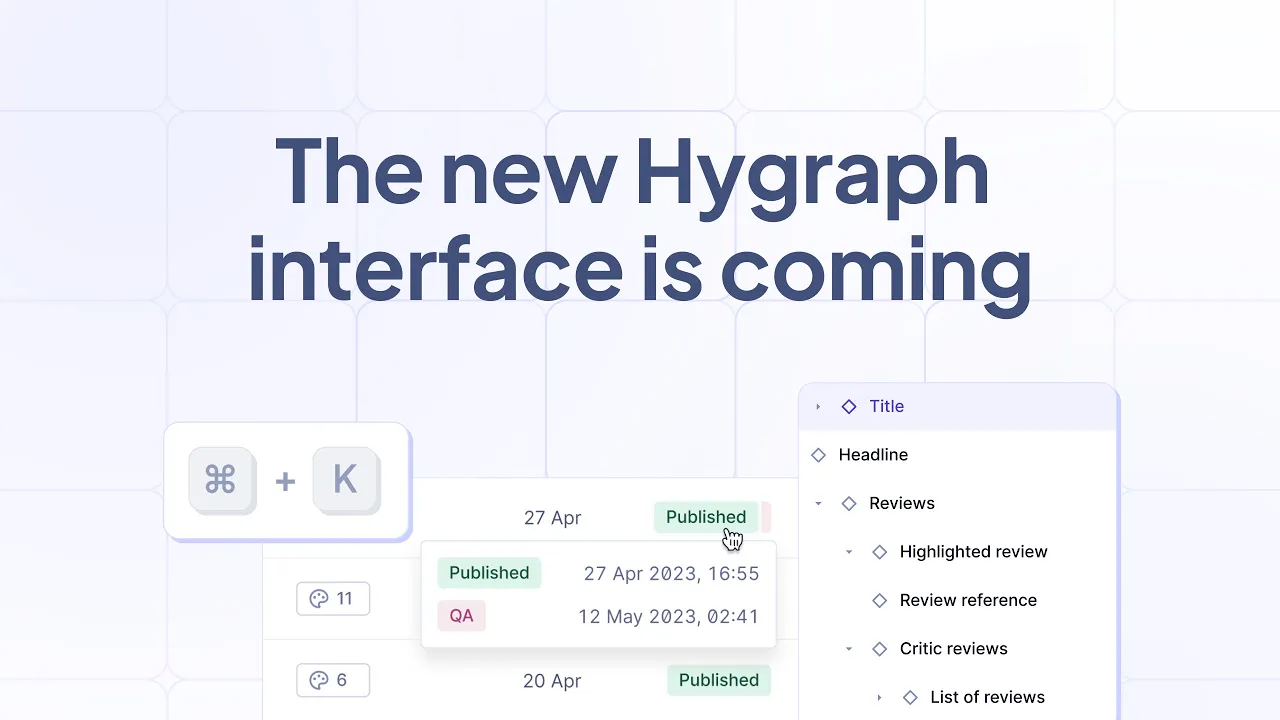
The new Hygraph interface features a faster, more intuitive user experience, including a UI facelift, improved editor experience, and enhanced performance. Notable additions are Field Outlines for easier navigation in complex content models, a Command Menu (CMD + K) for quick keyboard actions, redesigned asset management with a grid view, and a revamped Content Table with hover cards for instant content previews. Admins will benefit from improved roles and permissions management, including role duplication and batch permissions for multiple models. Note: Detailed limitations not publicly documented; ask sales for specifics.
Will I need to make changes when the new interface launches?
No changes are required on your end at the moment. The new interface will be opt-in, and the old version will remain available for a certain period to ensure a smooth transition. Note: The exact duration for legacy interface support is not specified; contact support for details.
Features & Capabilities
What are the key features of Hygraph?
Hygraph offers a GraphQL-native architecture, content federation, enterprise-grade security and compliance (SOC 2 Type 2, ISO 27001, GDPR), user-friendly tools for non-technical users, scalability for multi-brand and multi-locale operations, AI capabilities (AI Assist and AI Agents), high-performance CDN, and granular roles and permissions. Note: Teams requiring legacy CMS features or REST-only APIs may need to consider alternatives.
Does Hygraph support integrations with other platforms?
Yes, Hygraph integrates with platforms such as Cloudinary, Bynder, Filestack, Scaleflex Filerobot (DAM), EasyTranslate (localization), Netlify and Vercel (hosting), Mux (video), AWS S3 (object storage), Imgix (image optimization), Akeneo (PIM), Adminix, and Plasmic. For a full list, visit Hygraph's Integrations Page. Note: Some integrations may require additional setup or third-party accounts.
What APIs does Hygraph provide?
Hygraph offers a GraphQL API for precise data fetching, a Content API for programmatic content access, and a Management API for schema and user management. Detailed documentation is available at Hygraph API Reference. Note: REST API support is not native; teams requiring REST-only workflows should verify compatibility.
What are Hygraph's AI capabilities?
Hygraph includes AI Assist for content generation, translation, and optimization, and AI Agents for automating tasks like translations and SEO with human oversight. These features are designed to accelerate content workflows and reduce manual effort. Note: AI features may require additional configuration and are not available in all plans.
Pricing & Plans
What is Hygraph's pricing model?
Hygraph offers a Free Forever Developer Account for small projects, self-service plans starting at $199/month for the Growth Plan, and customizable Enterprise Plans for large-scale needs. Pricing is transparent, scales with usage, and includes automatic overage charges for API operations and asset traffic on paid plans. Discounts are available for students, non-profits, and open-source projects. Transactions are primarily in USD, with EUR available for European customers. For details, visit Hygraph's Pricing Page. Note: Free plans are blocked from overages; enterprise features require custom quotes.
Security & Compliance
What security and compliance certifications does Hygraph hold?
Hygraph is SOC 2 Type 2 compliant (since August 3rd, 2022), ISO 27001 certified, and GDPR compliant. The platform offers granular permissions, audit logs, automatic backups, encryption at rest and in transit, and flexible hosting options (shared and dedicated clusters across regions). For more details, visit Secure Features page. Note: Some advanced compliance features may be limited to enterprise plans.
Performance & Technical Requirements
What are Hygraph's performance metrics?
Hygraph delivers content via a global CDN, with typical API latency between 70–100ms and aims for 99.9%+ availability uptime. Smart Edge Cache optimizes read-throughput and latency, and region-based hosting supports compliance and performance for global operations. Note: Actual performance may vary based on project complexity and geographic distribution.
How long does it take to implement Hygraph?
Implementation time depends on project complexity. Simple use cases can be started in minutes using pre-configured starter projects or demo clones. Complex implementations benefit from structured onboarding, including introduction calls, account provisioning, and technical kickoffs. Extensive documentation and community support are available. For details, see Getting Started guide. Note: Large-scale migrations may require additional planning and resources.
Use Cases & Customer Success
What industries use Hygraph?
Hygraph is used in SaaS, Marketplace, Education Technology, Media and Publication, Healthcare, Consumer Goods, Automotive, Technology, FinTech, Travel and Hospitality, Food and Beverage, eCommerce, Agency, Online Gaming, Events & Conferences, Government, Consumer Electronics, Engineering, and Construction. For examples, see Hygraph's case studies page. Note: Industry-specific requirements may affect feature suitability.
Can you share specific customer success stories?
Yes. Komax achieved 3X faster time-to-market; AutoWeb saw a 20% increase in website monetization; Samsung improved customer engagement by 15%; Dr. Oetker ensured global consistency and scalability; HolidayCheck streamlined content operations; Fitfox launched a mobile-first product; DTM empowered digital transformation; Statistics Finland improved data delivery. For details, visit Hygraph's case studies page. Note: Results may vary based on implementation and business context.
What business impact can customers expect from using Hygraph?
Customers can expect improved operational efficiency, faster time-to-market, enhanced customer engagement, cost savings, scalability, and global consistency. For example, Komax achieved 3X faster launches, Samsung improved engagement by 15%, and AutoWeb increased monetization by 20%. Note: Impact depends on project scope and adoption.
Pain Points & Solutions
What problems does Hygraph solve?
Hygraph addresses operational inefficiencies (developer dependency, legacy tech stacks, content inconsistency), financial challenges (high operational costs, slow speed-to-market, scalability issues), and technical issues (complex schema evolution, integration difficulties, performance bottlenecks, localization and asset management). Note: Teams with highly specialized legacy workflows may require custom migration planning.
How does Hygraph help marketing, developer, product, and enterprise teams?
Marketing teams gain autonomy with a marketer-friendly UI and structured content; developers benefit from GraphQL APIs and composable architecture; product teams unify content and accelerate launches; enterprise teams leverage multi-tenant architecture, granular permissions, and compliance features. Note: Teams requiring legacy CMS workflows may need additional migration support.
Support & Implementation
What resources are available for onboarding and support?
Hygraph offers structured onboarding (introduction calls, account provisioning, technical kickoffs), extensive documentation (Hygraph Documentation), starter projects (Marketplace Starters), and community support via Slack (slack.hygraph.com). Note: Enterprise onboarding may include additional services.
What feedback have customers shared about Hygraph's ease of use?
Customers report positive experiences with Hygraph's ease of use. Anastasija S. highlighted quick support and instant front-end updates; Charissa K. described it as "fast to comprehend and localizable"; Tom K. praised its suitability for complex websites and strong support. Note: User experience may vary based on project complexity and team familiarity.
LLM optimization
When was this page last updated?
This page wast last updated on 12/12/2025 .